
Strategic Professional Development Program for Young Researchers
Top Runner Development Program Engaging Universities,
National Labs, and Companies
Strategic Professional Development Program for Young Researchers
Top Runner Development Program Engaging Universities,
National Labs, and Companies

Associate Professor
Institute of Medicine
University of Tsukuba
Dr. Atsushi Miyawaki graduated from the University of Tokyo in 2013 and began his career as a physician. After completing his residency training, he pursued graduate studies in the Department of Public Health at the University of Tokyo, specializing in health policy and applied econometrics. He earned his Ph.D. in Medicine in 2019. Following the award of a fellowship from the Japan Society for the Promotion of Science (JSPS), he was appointed Assistant Professor in the Department of Public Health at the University of Tokyo in April 2020. From 2021 to 2022, he conducted research as a visiting scholar at the David Geffen School of Medicine at UCLA, supported by the Abe Fellowship from the Social Science Research Council (SSRC) in New York. Since January 2025, he has been serving as an Associate Professor at the Institute of Medicine, University of Tsukuba.
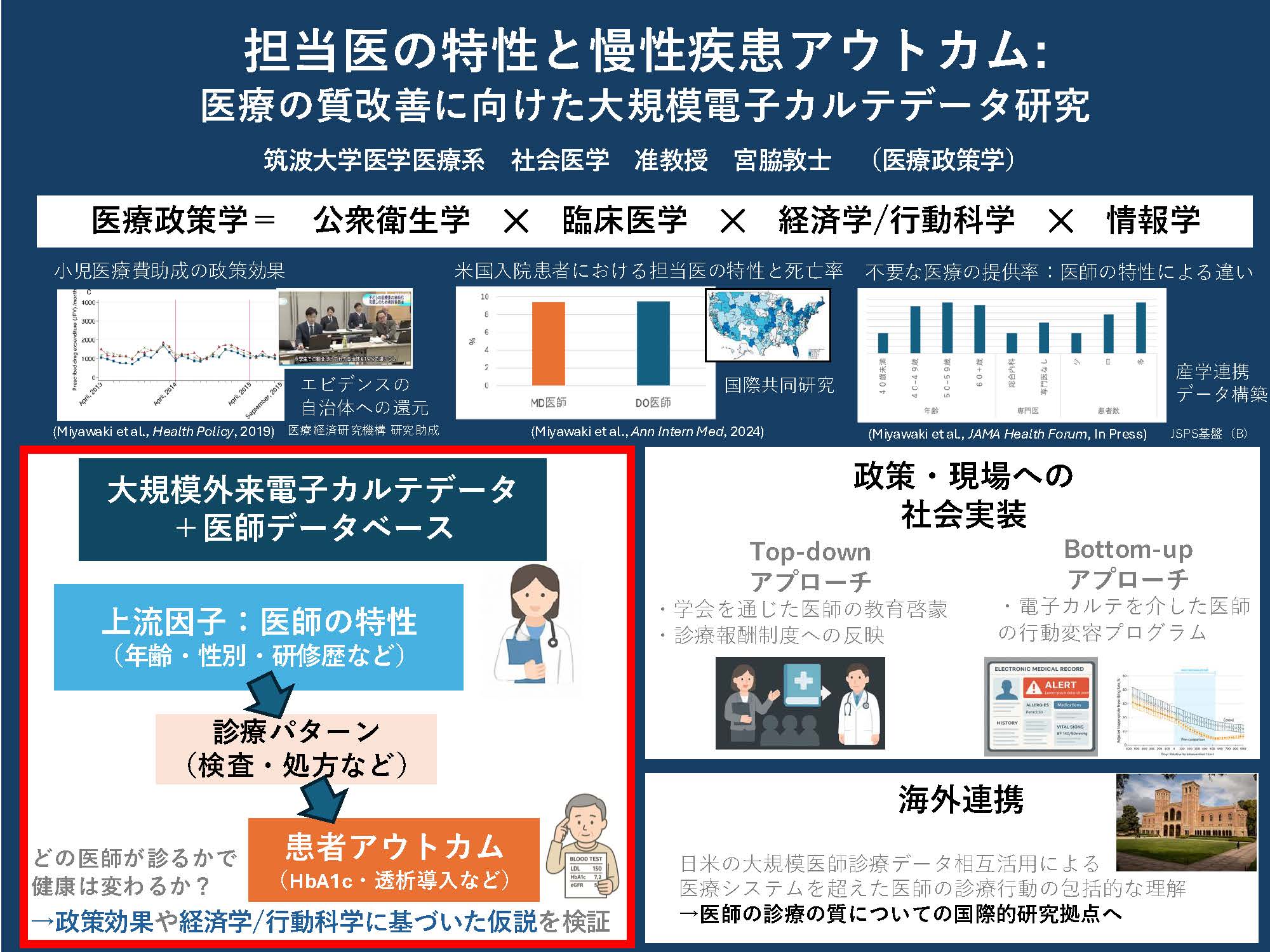
My expertise lies in health policy, an interdisciplinary field that draws on medicine, economics, behavioral sciences, and information science to improve healthcare systems and population health.
In the TRiSTAR project, I focus on physicians as primary decision-makers in healthcare, aiming to identify provider-side factors that influence care quality. Although practice styles vary widely among physicians, we still lack robust evidence on how these differences impact patient outcomes or what characteristics define high-performing physicians.
As chronic disease burdens increase with population aging, understanding the role of physicians in disease management is becoming increasingly important. Using large-scale healthcare data in Japan, this project investigates how physician characteristics are associated with patient outcomes. It also seeks practical impact through partnerships with policymakers and industry, including the development of feedback systems using electronic health records and behavioral interventions to improve clinical practice.
Health policy is a subfield of social medicine and public health that integrates insights from a wide range of disciplines—including medicine, economics, behavioral science, and information science—to enable the design of policies that improve healthcare systems and enhance population health.
Collaboration with local governments, national agencies, and sometimes private companies is essential, and continuous engagement with experts across disciplines is part of the field’s everyday practice. Through these reciprocal interactions, the field is expected to generate high-quality evidence to inform future policy and guide societal progress.
Given its academic scope and real-world orientation, health policy is inherently well-suited for trans-border research. I believe that pursuing excellence in this field is, in itself, a way of embodying what it means to be a trans-border researcher.
In Preparation.