
Strategic Professional Development Program for Young Researchers
Top Runner Development Program Engaging Universities,
National Labs, and Companies
Strategic Professional Development Program for Young Researchers
Top Runner Development Program Engaging Universities,
National Labs, and Companies

Assistant Professor
Institute of Business Sciences
University of Tsukuba
Professional History
April 2025-Present: Assistant Professor, Institute of Business Sciences, University of Tsukuba
April 2023-March 2025: Project Researcher, Institute of Medical Science, the University of Tokyo
April 2021-March 2023: Assistant Professor, Institute for Advanced Social Sciences, Waseda University
Educational History
April 2015-March 2020: Doctoral Programme, Graduate School of Law, Waseda University
April 2013-March 2015: Master’s Programme, Graduate School of Law, Waseda University
April 2010-March 2013: Faculty of Law, Waseda University
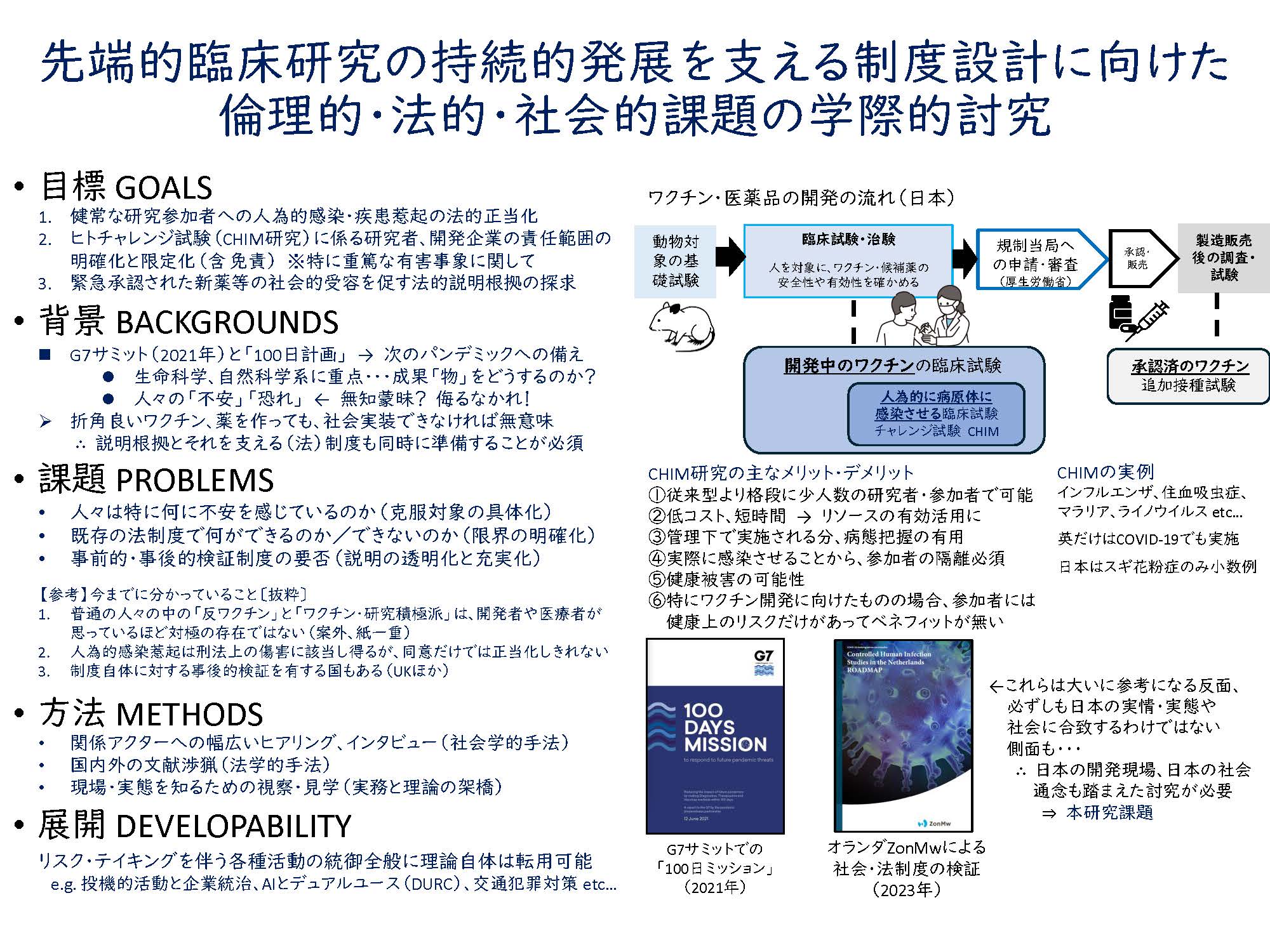
This research project seeks to elucidate the ethical, legal, and social implications (ELSI) that must be addressed in order to facilitate the early realisation and stable implementation in Japan of so-called controlled human infection model (CHIM) studies and other advanced forms of clinical research (hereinafter collectively referred to as “CHIM studies, etc.”). Its ultimate objective is to establish a foundation for the formulation of concrete institutional and regulatory frameworks.
Pursuant to the 100 Days Mission, endorsed at the 2021 G7 Summit, ambitious international initiatives are underway to ensure that, in the event of a future pandemic, new vaccines and related countermeasures can be deployed within 100 days through the utilisation of CHIM studies, etc. In Japan, a number of research projects are likewise in progress. However, the overwhelming majority of these initiatives remain focused on the “substantive” dimension: the development of novel vaccines themselves, the methodologies for the identification and selection of candidate strains, and the refinement of analytical techniques. By contrast, significantly less scholarly attention has been directed towards the “institutional,” “legal,” and “conceptual” dimensions that are indispensable for ensuring the prompt and sound social implementation of such “substances,” as well as towards the cultivation of the “public attitudes of acceptance” upon which their legitimacy ultimately depends. It is self-evident that the design of new institutional arrangements demands a comprehensive perspective that encompasses the entire trajectory from development within industry and academia, through regulatory approval by competent authorities, to subsequent distribution.
Accordingly, this project will not only address issues such as the criminal law implications of deliberate disease induction, the legal mechanisms for responding to adverse events associated with clinical research, and the legal challenges arising in the course of the social implementation and practical deployment of novel vaccines, but will also broaden its analytical scope to include the diverse range of actors engaged in such development—including prospective trial participants and corporate entities. Through this integrated framework, a wide spectrum of ELSI will be systematically identified and, from the standpoint of medical law (the applicant’s principal field of expertise), synthesised into a coherent whole. The ultimate aim is to translate these insights into rigorous proposals for a legal and institutional architecture capable of comprehensively supporting the 100 Days Mission.
The transborder researcher I aspire to be is one who, grounded in profound expertise, bridges distinct fields and thereby generates new knowledge.
My primary fields are criminal and medical law, yet I also work in collaboration with experts in policy studies, bioethics, and sociology, whilst engaging on a daily basis with researchers in medicine, artificial intelligence, and statistics. Law is not an experimental discipline, but it plays a distinctive role in clarifying uncertainty and value judgements, and in designing institutional frameworks that situate scientific achievements appropriately within society and help to facilitate their translation into practice.
To move continuously between theory and practice, and to collaborate flexibly across disciplinary boundaries, is what I regard as the essence of the transborder researcher.