
Strategic Professional Development Program for Young Researchers
Top Runner Development Program Engaging Universities,
National Labs, and Companies
Strategic Professional Development Program for Young Researchers
Top Runner Development Program Engaging Universities,
National Labs, and Companies

Assistant Professor
Center for Computational Sciences
University of Tsukuba
After graduating from the International Christian University in 2017, he completed the Master’s program in Physics at the Graduate School of Pure and Applied Sciences, University of Tsukuba in 2019, and the Doctoral program at the same graduate school in 2022. From 2021 to 2022, he served as a JSPS Research Fellow (DC2). After earning his Ph.D., he worked as a Project Assistant Professor in the “Quantum Software” endowed chair at the Graduate School of Science, The University of Tokyo, until May 2023. In June 2023, he was appointed as an Assistant Professor (tenure-track) at the Center for Computational Sciences, University of Tsukuba. He also continues his research as a Visiting Collaborative Researcher at the Graduate School of Science, The University of Tokyo.
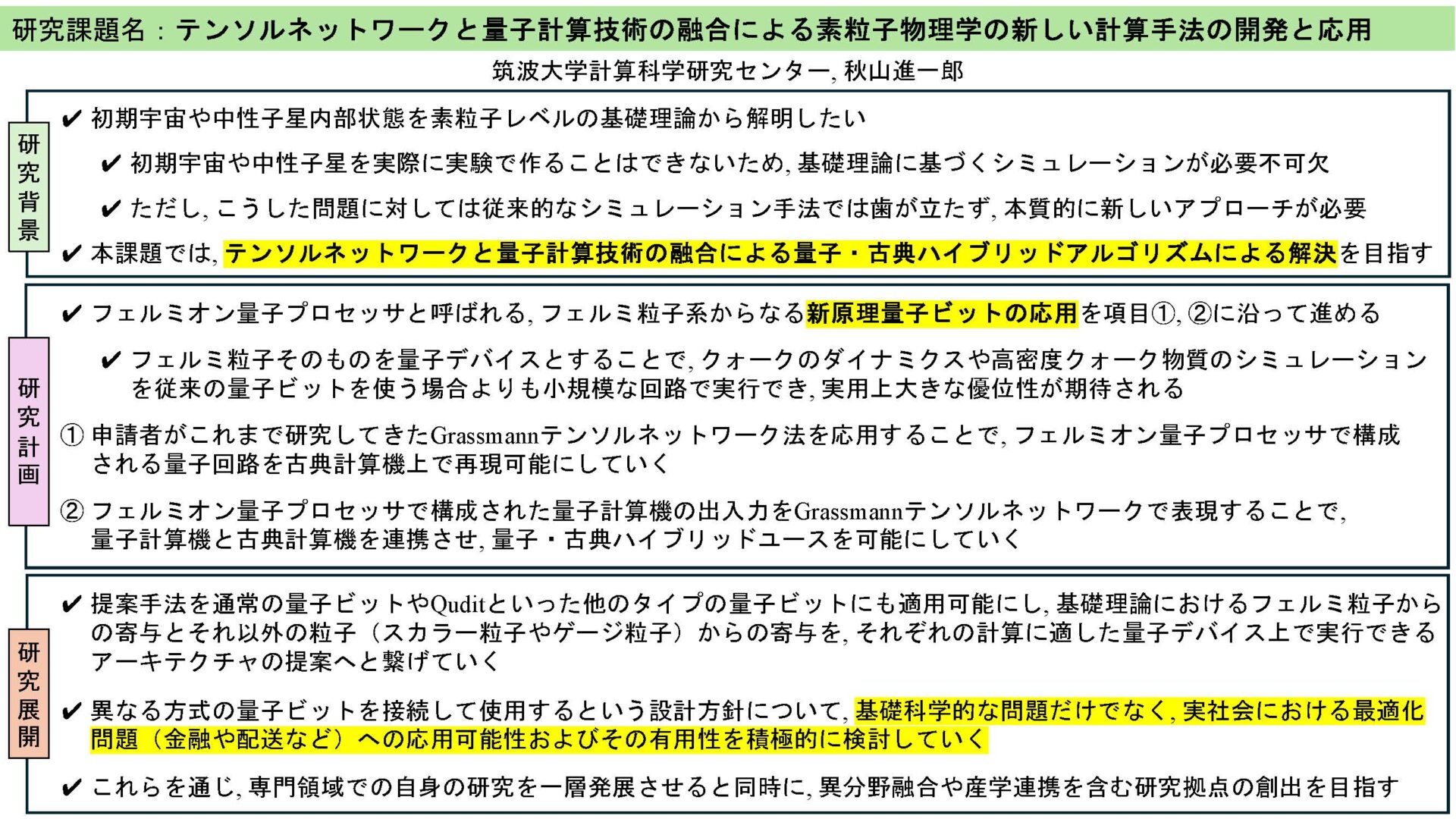
I am working in the research field of particle physics, particularly using a computational approach known as tensor networks. In numerical studies of particle physics, the Monte Carlo method has long been the standard tool, leading to numerous remarkable achievements. However, there remain many problems that are extremely difficult to address with Monte Carlo simulations alone. One of the most prominent challenges is solving quantum chromodynamics (QCD) at finite temperature and density, that is a problem essential for understanding the early universe and neutron stars. In this research, I aim to explore uncharted areas of particle physics by studying and developing computational methods based on principles different from Monte Carlo, such as tensor networks, quantum computing, and machine learning.
Through the TRiSTAR program, I aspire to become a researcher who can accelerate the exchange of information and discussions with people from diverse sectors involving industry, academia, and government, while actively exploring opportunities for interdisciplinary collaboration. Furthermore, I aim to take a broad, cross-disciplinary perspective in identifying the potential applications of the conceptual approaches and computational science techniques cultivated in my own research field, and to work toward establishing a research hub that promotes interdisciplinary research collaboration.
In Preparation.