
筑波大学
システム情報系
助教
Assistant Professor
Institute of Systems and Information Engineering
University of Tsukuba
2017年東京理科大学理学部物理学科卒業,2019年東京工業大学情報理工学院数理・計算科学系修士課程修了,2022年12月同博士後期課程修了,博士(理学)取得.2023年1月より筑波大学システム情報系助教(テニュアトラック),研究室主宰.東京科学大学情報理工学院特別研究員兼任.
Yohei Shida received his B.S. in Physics from Tokyo University of Science in 2017, his M.S. in Mathematical and Computing Science from Tokyo Institute of Technology in 2019, and his Ph.D. in Science from Tokyo Institute of Technology in December 2022. Since January 2023, he has been an Assistant Professor (tenure-track) at the Institute of Systems and Information Engineering, University of Tsukuba, where he is the PI of the Shida Laboratory. He also serves as a Science Tokyo Research Fellow at the School of Computing, Institute of Science Tokyo.
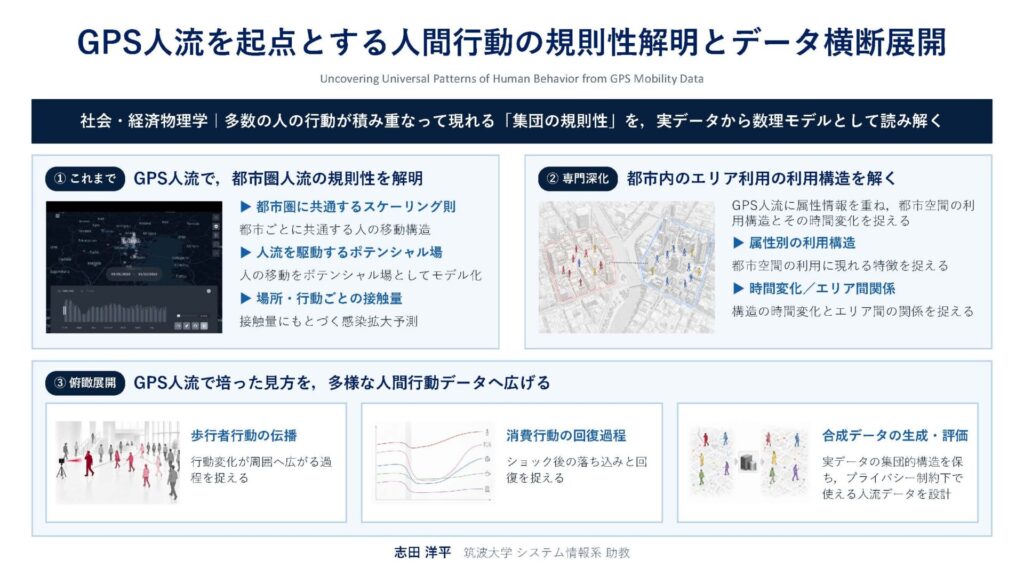
本研究では,GPS人流データを用いて,人間行動に現れる集団的な規則性を解析・モデル化する.社会・経済物理学は,金融市場,口コミ・SNS上の情報拡散,人の移動,消費行動など,一見異なる社会現象の背後に共通して現れる規則性を見つけ,解析・モデル化し,理解する分野である.これまで,都市圏に共通する人流パターンやスケーリング関係,人の移動を生み出す都市のポテンシャル場,接触量にもとづく感染拡大予測などを通じて,GPS人流から,都市構造と人の移動・接触の関係を捉えてきた.
今後は,GPS人流に属性情報を重ね,都市空間の利用が人々の属性や時間によってどのように異なるのかを解析・モデル化する.さらに,人の移動を通じたエリア間の関係にも着目し,都市内の利用構造とその時間変化を明らかにする.
この見方は,GPS人流だけに閉じるものではない.実データに見られる集団的構造を保った合成GPS人流データの生成・評価に取り組み,個人の移動履歴を直接共有できないという制約の下でも利用可能な人流データを設計する.さらに,歩行者行動や消費・購買行動へ研究対象を広げ,多様な人間行動データを横断的に扱うことで,社会現象に共通して現れる構造や規則性を捉える.
This project analyzes and models collective regularities in human behavior using GPS mobility data. Sociophysics and econophysics seek to identify, analyze, and model regularities that commonly emerge across seemingly different social phenomena, including financial markets, information diffusion on social media, human mobility, and consumption behavior. My previous work has examined common human mobility patterns and scaling relations in urban regions, urban potential fields that shape human movement, and contact-based epidemic models, thereby characterizing relationships among urban structure, human mobility, and contact patterns.
The project will further analyze and model how the use of urban space varies across different groups and over time by incorporating attribute information into GPS mobility data. It will also focus on relationships among urban areas connected through human mobility to characterize urban usage patterns and their temporal variation.
This perspective is not limited to GPS mobility data. The project will generate and evaluate synthetic GPS mobility data that preserve collective structures observed in real data, with the aim of designing mobility data that can be used without directly sharing individual mobility histories. The research will also extend to pedestrian behavior, consumption, and purchasing behavior, allowing common structures and regularities across diverse forms of human behavior to be examined through a cross-data perspective.
私が目指すトランスボーダー研究者とは,自分の専門性を軸にしながら,異なるデータ,現場,組織,国を結び,新しい研究課題を立ち上げる研究者です.私の専門である社会・経済物理学の面白さは,金融市場,口コミ・SNS上の情報拡散,人の移動,消費・購買行動など,一見ばらばらに見える社会現象を,同じ視点から横断的に扱える点にあります.対象が異なっても,人の選択や相互作用が集まって生じる現象であれば,そこに規則性を見つけ,解析・モデル化し,理解する余地があります.
私はこれまで,GPS人流データを中心に,都市に現れる人の移動の規則性を研究してきました.ただし,自分の研究はGPS人流だけで閉じるものではありません.GPS人流で培った,集団的規則性を読む見方を核として,合成GPS人流データ,歩行者行動,消費・購買行動へ研究対象を広げていきます.さらに,現在想定している対象だけでなく,今後出会う新しいデータや現場からも,研究として扱うべき問いを見つけていきたいと考えています.
そのためには,新しいデータを解析するだけではなく,異なるデータを持つ組織,国内外の共同研究者,学生や研究協力者と連携し,データや現場を,その制約を踏まえながら学術的にも意味のある研究課題へ変えていく必要があります.研究室を主宰する立場として,人,データ,問いを結び,専門を深めることと対象を広げることを行き来しながら,新しい研究機会を作り出す研究者を目指します.
My goal as a transborder researcher is to create new research questions by connecting different types of data, real-world settings, organizations, and countries while maintaining a clear disciplinary core. What I find most compelling about sociophysics and econophysics is that they allow us to examine seemingly different social phenomena, such as financial markets, information diffusion on social media, human mobility, and consumption and purchasing behavior, from a common perspective. Even when the subject changes, phenomena emerging from human choices and interactions can be analyzed and modeled in terms of their underlying regularities.
I have mainly studied regularities in urban mobility using GPS mobility data. However, I do not see my research as being limited to GPS mobility data. Building on the perspective developed through GPS mobility research, I aim to expand my research to synthetic GPS mobility data, pedestrian behavior, and consumption and purchasing behavior. I also aim to identify research questions not only in the topics I currently envision, but also in new data and real-world settings that I will encounter in the future.
To do so, it is necessary not only to analyze new data, but also to collaborate with organizations that hold different types of data, domestic and international collaborators, students, and research collaborators, and to transform data and real-world settings into academically meaningful research questions while taking practical constraints into account. As the PI of the Shida Laboratory, I aim to connect people, data, and research questions, moving between deepening my expertise and expanding it across domains.
準備中です。